
As a writing teacher, I tell my students to never begin their essays with, “According to the Merriam-Webster dictionary…” The rhetorical move is so boring, and it’s rarely helpful to their overall argument. However, I just spent a week in Tampa with 1,600 teachers of writing, assessing over a million AP English Language exams. The exam I scored asked students to apply a particular term to a concept of their choice, and it was clear that some students had NO idea what the term meant — which made for some very amusing essays. All this to say, words have meanings, and it’s important to know what those meanings are — even if you end up challenging them.
In Paula’s emails to our small team about travel logistics, she has called us “Georgia pilgrims.” The phrase is lovely, though each word separately has multiple meanings — Georgia, most frequently referring to a southeastern state known for peaches, and pilgrims, most commonly known as Thanksgiving attendees or those making trips to Mecca. However, clarifying this phrase helps explain what our team will be doing and how we will approach our trip to Georgia.
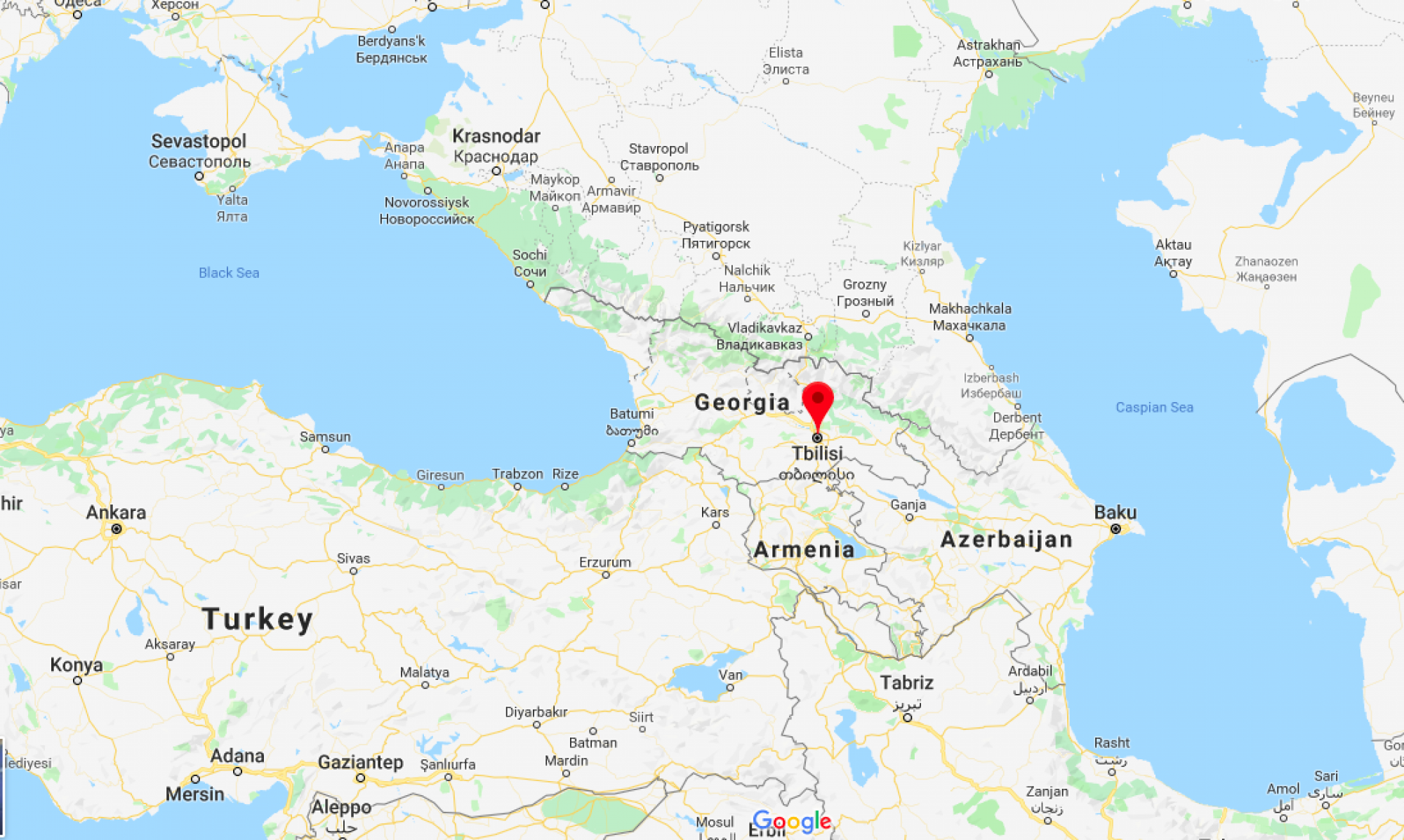
First of all, Georgia. Our destination actually takes us out of the United States, to what used to be called the Democratic Republic of Georgia until it became a Soviet republic in the early 1920s. It regained its independence in 1991, and honestly, I don’t know much more about Georgian history than that. Luckily, I have a long travel day ahead to do some research. I do know that Georgia is located at the boundary between Eastern Europe and Western Asia, bordered by the Black Sea, Russia, Turkey, Armenia, and Azerbaijan (which has always been my favorite country name). We will be in Tbilisi with the Bishop of Peace Cathedral, Malkhaz Songulashvili, and his community, celebrating Pentecost. We have also been invited to a religious festival of the Yezidi religious sect, who have a temple in Tbilisi, and we will be hearing from some of the Yezidi community who have faced religious and ethnic persecution under ISIS and the Kurdish government.
This brings me to the second word, pilgrims. I’m going to break my own rule and refer to the Merriam-Webster dictionary.
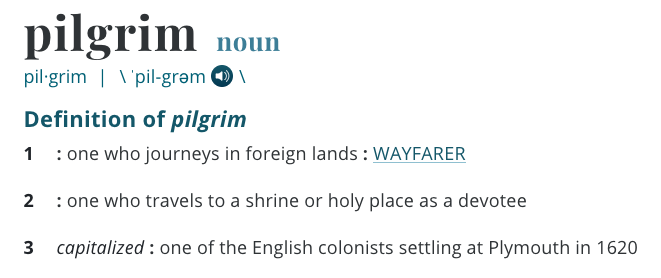
As we journey to Georgia, not entirely certain what stories we will hear or what experiences we may have, I have these definitions in my mind of what it can mean to be a pilgrim. First, one who travels abroad, who is an outsider and does not belong. To me, this primary definition reminds me to respect the history, the land, and the people I will encounter. I am only a wayfarer, someone who is briefly entering their world and who will not be able to understand it fully. However, I can be present and participate in the ways most respectful and appropriate for my role as a pilgrim, only seeing a slice of what it means to be Georgian or Yezidi.
Second, one who travels to a holy place. I met someone recently who had been to Georgia not long ago, and while he is an atheist, he said that he felt something in Georgia, a connection to the land and its spirit, that felt sacred. He was moved by this place, and I imagine I will be as well. I will be encountering a different type of Christian worship, one greatly influenced by the Orthodox faith tradition, and a different type of religion altogether, as we learn from the Yezidis about their beliefs and culture. As someone who is convinced of the necessity of interfaith collaboration and communication, I wish to be a pilgrim in this regard, even if the holy places I encounter are not from my particular faith tradition.
Lastly, I want to remember the legacy of the third definition, how often pilgrims have colonized and forced their faith onto the inhabitants of the lands they encountered, and how this resulted in the eradication of entire legacies, languages, religions, and often the people themselves. I want to be aware of that abuse of power, privilege, and perspective as I travel, particularly as we hear from the Yezidis about their experiences with faith-based charities in refugee camps that sometimes take advantage of their vulnerability and do not respect the fragility and importance of their religion and culture. As a white American Christian, I must identify and refute those practices, both past and present, whenever possible.
We are about to embark on our pilgrimage, holding to definitions 1 and 2 (and remembering definition 3) from good ole Merriam-Webster. I hope to be able to update this blog frequently, depending on time and WiFi access. Our team would ask for your prayers and your openness to what we experience during our time in Georgia.
Thank you for your support, from this particular Tbilisi pilgrim.
 Tbilisi Pilgrims